
How to Build a ₹1 Crore Portfolio with SIP in India

Article link copied!
Arjun is 24, earns ₹45,000 a month, and has written off ever having serious money.
Then he actually runs the math. A ₹10,000 SIP, stepped up 10% a year, hits the
₹1 crore mark before he turns 40.
No inheritance. No hot tips. No windfall. Just one recurring transaction and enough
patience to leave it alone. That's
the whole plan.
Why Your 20s Are Your Biggest Financial Asset
Your salary will grow. Your skills will sharpen. But you cannot buy back time in the market. Compounding is not a metaphor — it's arithmetic. A rupee invested at 25 generates returns that themselves generate returns, over and over, for decades. Wait until 35 and you lose ten of those years. That gap costs more than most people ever account for.
🧓 The Late Starter
Starts a ₹10,000/month SIP at age 35 @ 12% annual return.
Reaches ₹1 Crore at age 52 — 17 years later.
🚀 The Early Mover
Starts the same SIP at age 25 @ 12% annual return.
Reaches ₹1 Crore at age 42 — 5 full years earlier, with the same monthly outflow.
The only difference between these two people is when they started. "I'll invest when I earn more" is a sentence that costs years, not just money.
⚠️ Before Your First SIP: Build This Safety Net
Before you put a rupee into equity, build an emergency fund. 3–6 months of expenses, sitting in a liquid fund or high-yield savings account. This isn't optional — it's what stops you from breaking your SIP the moment something goes wrong. A job loss, a medical bill, a busted appliance — any of these can derail compounding if you haven't planned for them.
If your monthly expenses are ₹30,000, keep ₹90,000–₹1.8 lakh untouched before investing anything in equity.
3 Strategies That Actually Get You There
Three approaches that work for salaried investors — each with a number attached.
Start Early, Stay Consistent
The most important question isn't which fund to pick — it's when to start. A modest SIP that runs for 20 years beats a larger one that runs for 10, almost every time. Set it to debit on salary day and you never have to remember it again.
Step-Up Your SIP Every Year
A step-up SIP raises your monthly contribution by 10–15% each year, roughly in line with a typical salary increment. Most AMCs let you configure this once and forget it. The effect on your timeline is real: you reach ₹1 crore years earlier without dramatically changing your monthly outflow.
Diversify Across Asset Classes
Equity does the heavy lifting on returns. Debt cushions the falls. Gold and silver hold value when markets and currencies get choppy. Diversification keeps you from panic-selling at the bottom — and that's where most wealth destruction actually happens.
Want a smarter framework for your SIP?
The 7-5-3-1 Rule gives you a structured way to think about expected returns, volatility, and how to set realistic milestones on your way to ₹1 crore — without getting blindsided by market noise.
Read: The 7-5-3-1 Rule of SIP Investing in Mutual Funds →Don't Let Taxes Eat Your Returns
What you earn matters. What you keep after tax matters more. The rules on mutual fund taxation aren't complicated, but ignoring them across a 15–20 year investment horizon is an expensive habit.
📈 Equity Funds
- • Gains under 1 year → STCG taxed at 20%
- • Gains above 1 year → LTCG taxed at 12.5% on profits over ₹1.25 lakh/year
- • Strategy: Hold for the long term. Don't churn funds chasing short-term gains.
💡 Tax-Saving Tip: ELSS Funds
Equity Linked Savings Schemes (ELSS) give you a ₹1.5 lakh deduction under Section 80C while keeping your money in equity markets. The lock-in is just 3 years — the shortest in the 80C basket — which makes them a practical starting point for young investors who don't want to sacrifice growth for a tax break.
5 Mistakes That Derail Young Investors (And How to Avoid Them)
Waiting to "learn more" before starting
A Nifty 50 Index Fund started today will almost certainly outperform a carefully researched portfolio started a year from now. The delay is the mistake, not the fund choice.
Pausing SIPs during market crashes
When the NAV drops, your fixed SIP buys more units for the same money. That's rupee cost averaging working in your favour. Stopping the SIP means you miss the cheapest units — and those are the ones that do the most work on the way back up.
Over-diversifying with too many funds
Twelve mutual funds don't give you twelve times the protection — most large-cap funds hold the same 50 stocks anyway. Two or three well-chosen funds across categories is enough. More funds just mean more noise.
Redeeming early for lifestyle upgrades
Pulling money out to buy a phone or fund a trip breaks compounding and triggers a tax event. Keep a separate savings account for lifestyle goals. The investment account should be boring and untouched.
Ignoring inflation when setting targets
₹1 crore today isn't ₹1 crore in 2040. At 6% inflation, its purchasing power drops to roughly ₹42 lakhs by then. Equity isn't optional for long-horizon goals — it's the only asset class that has consistently beaten Indian inflation over multi-decade periods.
Why Our Plans Are Built for You
Get the Right Funds for You
No commissions. No conflicts of interest. Fund recommendations and asset allocation built around your income, goals, and risk appetite — not ours.
Invest as a Family
Create portfolios across multiple family member accounts — spouse, parents, or kids. Plan goals together, track progress together, and build wealth as a unit.
Personalise Your Growth Strategy
Set a target — like ₹1 crore in 15 years — tag your existing investments to it, and see exactly how far you are and what it takes to close the gap.
Most people don't build wealth because they never start. That's genuinely it. Start a SIP this week. Increase it next year. Don't touch it. That's the whole plan.
Free Tool
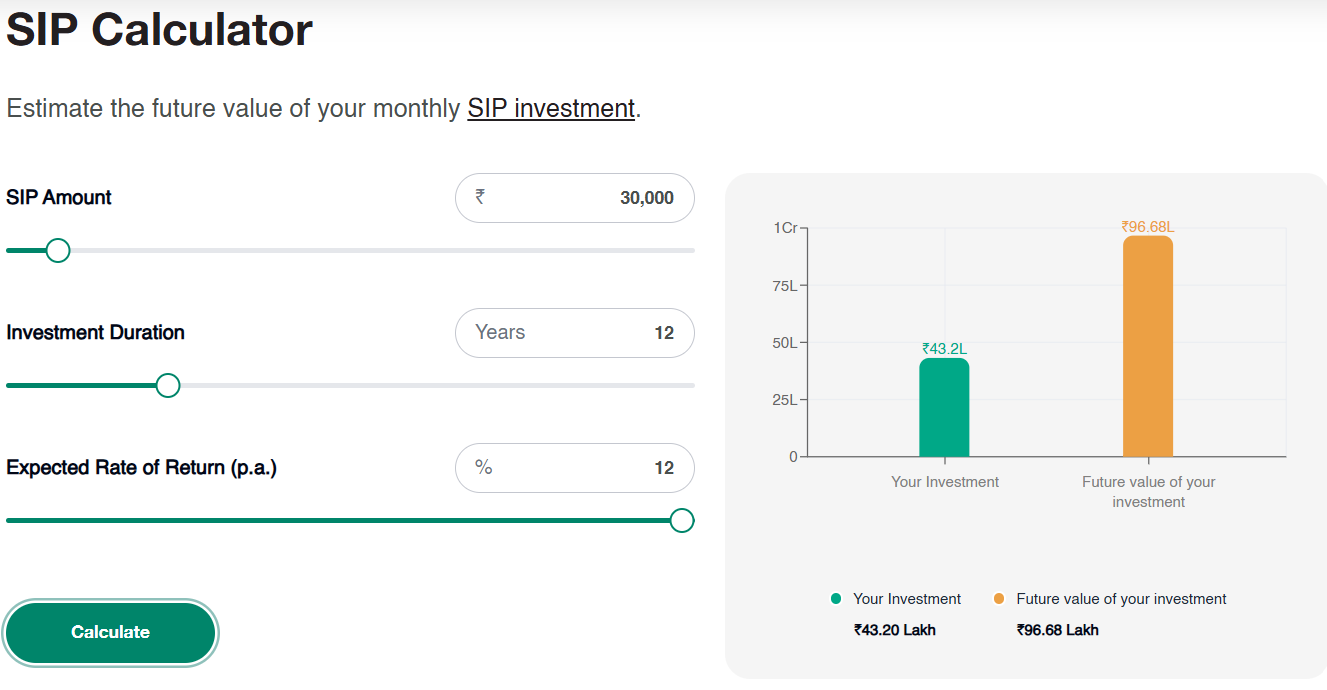
Try Our SIP Calculator
Plug in your monthly amount, return rate, and timeline — and see exactly when you'll cross ₹1 crore. Takes 30 seconds.
Ready to start your investment journey?
Our team is ready to guide you through every step of the process.
Completely

How to Build a ₹1 Crore Portfolio with SIP
A step-by-step guide for salaried Indian investors to reach ₹1 crore through systematic SIP investing in mutual funds.
Frequently Asked Questions
Share this article
Article link copied!